Service Hotline
+86 18101795790
+86 18101795790
Contact:Gensors
Phone:+86 18101795790
TEL:+86 021-67733633
Email:sales@bmbond.com
Address:22, Lane 123 Shenmei Road Pudong New District Shanghai, China
The pressure scanning valve is a critical and widely used data acquisition device in aerodynamic testing, particularly
in wind tunnels. It significantly enhances the efficiency and accuracy of pressure measurement, making it an
indispensable tool for modern aerodynamic research.
1. Primary Applications in Testing
Pressure scanning valves are primarily used in wind tunnel tests, including:
Full-Scale or Component Model Testing: Measuring pressure distribution on wings, fuselages, and tail surfaces
under various angles of attack and Mach numbers.
Inlet Testing: Densely mapping pressure on engine inlet surfaces to determine total pressure recovery and
distortion indices, which are vital for engine stability.
Propeller/Rotor Testing: Measuring dynamic pressure distribution on rotating blades to study aerodynamic loads
and performance.
Automotive Aerodynamics: Analyzing surface pressure on car models to optimize body shape and reduce drag
and wind noise.
Building Aerodynamics: Measuring wind pressure distribution on architectural models to inform structural design.
2. Purpose and Validation Supported by Test Data
The high-density pressure data supports:
Aerodynamic Load Validation: Integrating surface pressures to calculate overall forces and moments, providing
direct validation for theoretical and CFD predictions.
Flow Field Analysis: Generating pressure contour plots to visualize key features like shock waves and flow
separation zones.
Performance Optimization: Comparing pressure distributions from different designs to identify configurations
that reduce drag or enhance lift.
CFD Model Validation: Serving as the "gold standard" for calibrating and verifying computational fluid dynamics
simulations.
3. Key Implementation Details
The deployment involves a systematic process:
System Components:
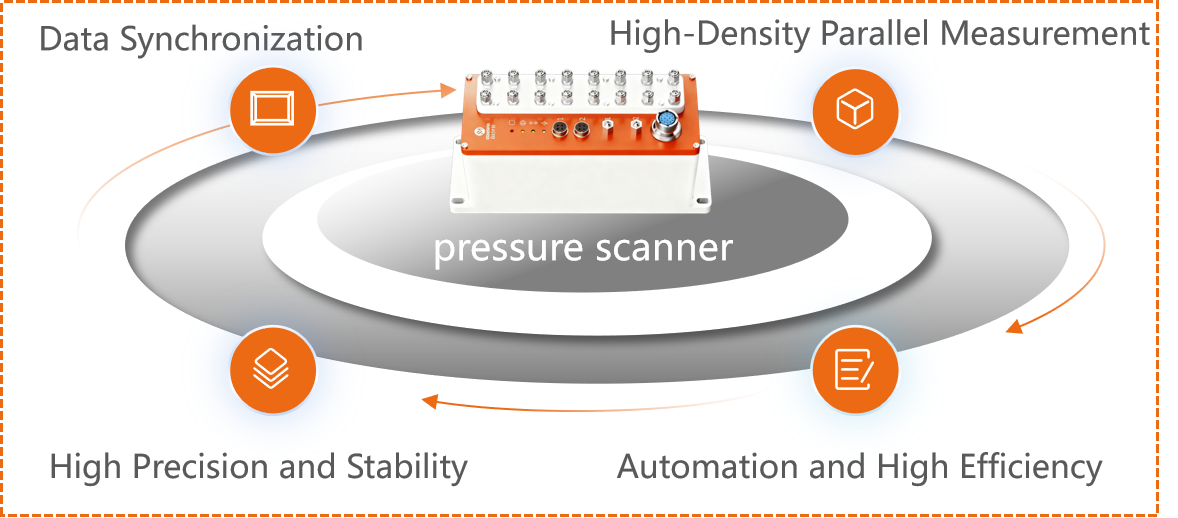
The scanner unit with a multi-channel, high-precision sensor array.
Pressure tubing connecting surface taps on the model to the scanner.
A data acquisition system for signal processing.
A calibration system using a precision reference pressure source.
Workflow:
Preparation: Strategically placing pressure taps based on CFD results and connecting them to the scanner via
leak-free tubing.
Calibration: Performing in-situ calibration before and after tests to ensure accuracy.
Data Acquisition: Capturing data from all channels at high speeds with high synchronization to "freeze"
transient flow states.
Processing: Converting raw data into pressure coefficients and generating visualizations like distribution curves
and contour plots.
Advantages Over Traditional Methods: Electronic scanning valves offer superior speed, channel count, and
synchronization compared to slower mechanical scanivalves, enabling large-scale, dynamic testing.
In summary, the pressure scanning valve acts as a bridge between physical wind tunnel testing and digital
aerodynamic analysis. It translates complex surface pressures into precise, synchronized digital data, providing
the foundational information needed to understand flow physics, validate designs, and optimize performance
in applications from aircraft wings to Formula 1 cars.


Copyright © 2009-2025 BM Genuine Sensing Technology (Shanghai)Co.,Ltd. All Rights Reserved.
Phone